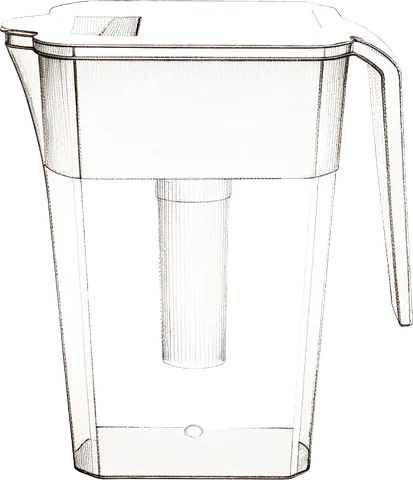
Pitcher and faucet filters
For chlorine taste, yes, a pitcher filter (the Brita style) earns its spot in the fridge. For health contaminants, the answer lives on the box: a model certified to NSF/ANSI 53 for lead genuinely reduces lead, while no pitcher reliably handles PFAS, chromium-6, or nitrate. Match the certification to what your water test actually found.
How it works
Water trickles by gravity through a cartridge of loose activated carbon granules. Carbon works by adsorption: chlorine and many organic chemicals stick to its surface as the water passes. A faucet-mount filter is the same media pushed by tap pressure instead of gravity. Two things follow from that design. First, contact time is short. A gravity trickle through loose granules gives each drop a brief encounter with the carbon, where a pressurized carbon block (the under-sink format) is denser, has finer pores, and holds the water against the media longer. Second, the cartridge can only do what its certification says it does. NSF/ANSI 42 covers aesthetics, mostly chlorine taste and odor. NSF/ANSI 53 covers health contaminants, lead being the big one. NSF/ANSI 58 covers reverse osmosis systems, and NSF/ANSI 401 covers a list of emerging contaminants. The marks printed on the box are the entire difference between a pitcher that improves taste and one that removes something that can hurt you.
What it handles, honestly
| Concern | Handled? | The honest note |
|---|---|---|
| Chlorine taste and odor | Yes | This is the NSF/ANSI 42 job, the aesthetic class, and any reputable pitcher does it well. Carbon holds chlorine readily even at short contact times. It is a taste fix, and the certification says exactly that. |
| Lead | Partly | Only with an NSF/ANSI 53 lead certification printed on that specific cartridge. Certified models must cut lead by 99% in standardized challenge testing. A basic taste-and-odor cartridge carries no lead claim at all, an overdue cartridge underperforms its rating, and particulate lead from old brass can spike past what any cartridge is rated to handle. |
| Trihalomethanes (THMs) | Partly | Carbon does hold THMs, but loose granules in a gravity pitcher give the water less contact time than a pressurized carbon block, and THM breakthrough arrives before any change in taste. A pitcher also does nothing for the shower, an exposure route research puts on par with drinking. |
| PFAS | Partly | The weakest tier. In the one large field study of home filters, pitcher and faucet-mount carbon was the least effective and most variable type tested. Better than nothing while you decide, but a home with detected PFAS needs reverse osmosis at the kitchen tap. |
| Chromium-6 | No | Chromium-6 is a small dissolved ion and passes straight through activated carbon. Removing it takes reverse osmosis or anion exchange. A carbon pitcher offers no meaningful protection here. |
| Nitrate | No | Carbon adsorbs organic chemicals and chlorine; dissolved mineral salts like nitrate pass through untouched. The same is true of perchlorate. Reverse osmosis handles both. |
| Hardness | No | A pitcher does not soften water. Hardness is a scale-and-comfort issue rather than a health concern, and the whole-house fix is an ion-exchange softener, with reverse osmosis covering the drinking glass. |
Getting it right
Change the cartridge on the calendar, never by taste. Taste-and-odor capacity outlasts health-contaminant capacity, so the water can taste filtered while the cartridge has stopped doing its health job, and a degraded cartridge underperforms its rating. Slow filtering is part of the design: contact time is what the carbon needs, so the pitcher that pours fastest is rarely the one filtering best. And buy for the certification, never the brand. The same brand often sells a basic taste cartridge and an NSF/ANSI 53 lead-certified cartridge side by side, and only the box tells you which one you are holding.
Common questions
Is a Brita filter good enough?
It depends on what your water test found. For chlorine taste, any certified pitcher does the job. For lead, a pitcher works only if that specific cartridge carries an NSF/ANSI 53 lead certification and you change it on schedule. For PFAS, chromium-6, or nitrate, no pitcher is the right tool; those call for reverse osmosis, or an under-sink carbon system for low-level PFAS in an adult-only household.
What do the NSF numbers on the box mean?
NSF/ANSI 42 is the aesthetic class: chlorine taste and odor. NSF/ANSI 53 is the health class, covering contaminants like lead. NSF/ANSI 58 covers reverse osmosis systems, and NSF/ANSI 401 covers emerging contaminants. Each certification applies to the specific contaminants listed on the product's data sheet, so a 53 mark for one contaminant says nothing about another.
How often do I need to change the cartridge?
On the manufacturer's schedule, tracked on a calendar. Breakthrough is invisible: a cartridge that has stopped removing THMs or lead still pours fine and still tastes filtered, because the taste capacity outlasts the health capacity. Waiting for the water to taste bad means running an expired filter without knowing it.
Are faucet-mount filters better than a pitcher?
Treat them as the same tier. Both run water through loose or thin carbon media with brief contact time, and the field data groups them together. The certification on the specific model matters far more than the form factor. The real step up is an under-sink carbon block, and above that, reverse osmosis.
When should I skip the pitcher and get something bigger?
When a test has found something a pitcher cannot hold. Detected PFAS points to reverse osmosis, especially in a household with children. Detected lead can work with an NSF/ANSI 53 pitcher, as long as the cartridge changes happen on schedule. Chromium-6, nitrate, and perchlorate pass through carbon, so those findings call for reverse osmosis regardless.
Sources
Government & regulatory
Institutional & standards
- NSF/ANSI 53: Drinking Water Treatment Units, Health Effects
- NSF/ANSI Drinking Water Treatment Unit standards (42, 58, 401)
Related
Curious what is actually in your water?
Get your free Stasis Score from just your address