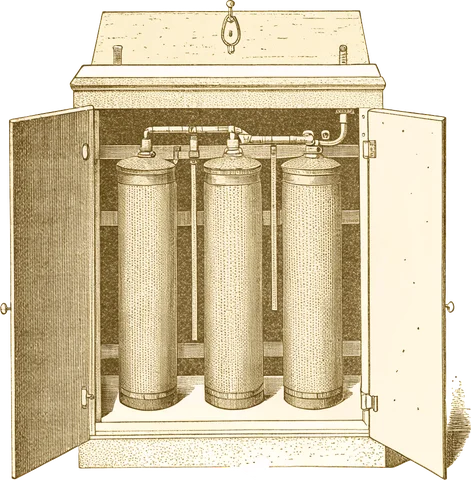
Reverse osmosis
Yes, reverse osmosis works, and it covers more water problems at once than any other filter you can put in a home. An under-sink unit certified to NSF/ANSI 58 removes lead, PFAS, hexavalent chromium, nitrate, and most other dissolved contaminants at the kitchen tap. It treats drinking and cooking water only, and the membrane needs replacement on a schedule.
How it works
Household water pressure forces water through a semipermeable membrane with openings so small that dissolved metals, salts, and most larger molecules are left behind and flushed to the drain. The clean water collects in a small tank under the sink and comes out a dedicated faucet. Practical units are multi-stage: a sediment pre-filter protects the membrane, and carbon stages before and after it catch the chlorine byproducts and solvent-type chemicals that carbon is good at. That stack is why one under-sink unit covers so much of a water test at once. The certification to look for is NSF/ANSI 58, the standard written specifically for reverse osmosis systems. NSF/ANSI 53 covers health claims for carbon-class filters, and NSF/ANSI 42 covers taste and odor only.
What it handles, honestly
| Concern | Handled? | The honest note |
|---|---|---|
| Lead | Yes | Certified under-sink systems take dissolved lead to non-detectable, and the sediment pre-stage catches the particulate lead flakes that a basic carbon-only cartridge can miss. |
| PFAS | Yes | Above 94 percent removal of long-chain and short-chain PFAS in the 73-home field study (Herkert et al., 2020), the only filter type consistent across the full PFAS range. Covers drinking water only, never PFAS from food packaging or cosmetics. |
| Chromium-6 (hexavalent chromium) | Yes | Rejects chromium-6 in the 90 to 97 percent range in published membrane studies. Carbon filters do not remove it, so detected chromium-6 plus an existing carbon block means an upgrade. |
| Nitrate | Yes | Carbon does not remove nitrate and boiling concentrates it, so RO is the clean fix. One standing caution: where nitrate is elevated, no baby under six months should drink even treated water, in case the system fails. |
| Trihalomethanes (THMs) | Yes | Removed at the tap, but overspecified if THMs are the only finding; a certified carbon block does that job for less. No kitchen-tap unit reaches the shower, where THMs are also inhaled. |
| Hardness | Yes | Softens drinking and cooking water at the one tap it serves. It does nothing for the pipes, water heater, or fixtures behind that tap; whole-house scale control is a softener's job. |
| 1,4-Dioxane | Partly | The molecule is small and uncharged, so a meaningful share passes the membrane. RO reduces it without being a complete barrier; the effective control is advanced oxidation at the utility. |
| NDMA and other nitrosamines | No | Small uncharged molecules that slip past RO and carbon alike. UV light is what breaks them down, a utility-scale process, so no cartridge should be sold as the answer here. |
Getting it right
An under-sink unit connects to the cold supply line, drains to the sink drain, and may need a hole for its own faucet, typically $300 to $1,500 installed. It treats the kitchen tap only, and that is the right scope: the contaminants RO exists for are ingestion problems, so the water you drink and cook with is the water that matters. Two honest costs come with it. Throughput is slower than a carbon block, and some rejected water goes down the drain for every gallon produced. Maintenance is the part people skip: the membrane lasts roughly 2 to 3 years, the carbon stages 12 to 24 months, and a spent filter gives no warning, no change in taste or flow. Put replacement on a calendar instead of waiting for a sign that never comes.
Common questions
Does reverse osmosis remove PFAS?
Yes. In a 73-home field study of home water filters, reverse osmosis removed more than 94 percent of both long-chain and short-chain PFAS, and it was the only filter type that performed consistently across the full range. The catch is scope: it cleans the water at one tap, and PFAS also reaches people through food packaging, dust, and cosmetics, which no water filter touches.
Is a carbon filter enough, or do I need reverse osmosis?
It depends on what a test finds. Carbon handles chlorination byproducts, solvent chemicals, lead, and taste. It does not touch the dissolved inorganics: chromium-6, nitrate, perchlorate, and fluoride pass straight through it. If a test shows chromium-6, nitrate, or perchlorate, RO is the answer. If chlorination byproducts are the only finding, a certified carbon block does the job for less money.
Does reverse osmosis waste water?
Some, yes. The membrane works by splitting the stream, so a portion of rejected water goes down the drain for every gallon of clean water produced. For an under-sink unit serving drinking and cooking water the volume is a real cost worth knowing about before you buy.
Do I need a whole-house reverse osmosis system?
Almost never. The contaminants RO is built for are ingestion problems, so the tap you drink from is the exposure point and a point-of-use unit covers it. Whole-house equipment earns its place for other jobs, like scale control with a softener or shower-route chlorination byproducts with whole-house carbon.
How do I know when to replace the membrane?
You will not be able to tell, which is the trap. A saturated membrane or cartridge shows no flow change and no taste change while contaminants pass through. Plan on a new membrane every 2 to 3 years and fresh carbon stages every 12 to 24 months, scheduled in advance with the dates written down.
Sources
Peer-reviewed
Government & regulatory
Institutional & standards
Related
Curious what is actually in your water?
Get your free Stasis Score from just your address