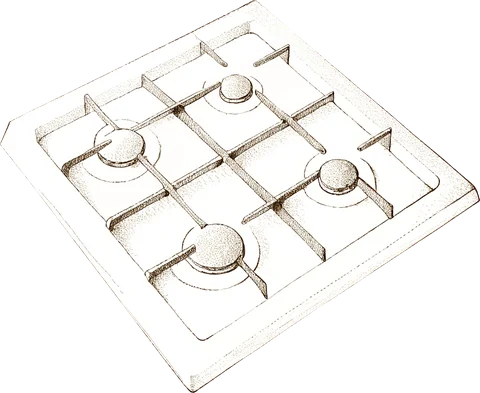
Is my gas stove a problem for my air?
Cooking on a gas burner releases nitrogen dioxide, fine particles, and benzene right where you breathe, and a tight modern home traps it. You do not have to rip out the stove. The fix that matters most is venting outside while you cook and running a filter after. About 13% of US childhood asthma traces to gas stove use, so the concern is real, not hype.
What the burner puts in your air
A lit gas burner is a small combustion engine in your kitchen. It gives off nitrogen dioxide and fine particles you can breathe deep into your lungs, plus a little benzene, a known carcinogen. The food itself adds more: pan-frying and stir-frying throw off the biggest bursts of fine particles, far more than the gas-versus-electric difference. Newer homes are built tight to save energy, which is good for your heating bill and bad for trapping what the stove gives off. With no path outside, a cooking cloud can hang in the air for ten hours.
How worried should you be
Worried enough to change how you vent, not worried enough to panic. Researchers estimate about 13% of childhood asthma in the US traces back to gas stove use, and in California the figure is closer to one in five cases. That puts it in the same range as secondhand smoke as a driver of kids' asthma. Children, anyone with asthma, and people in small or poorly ventilated kitchens carry the most risk. The stove is a real source. It is also one of the most fixable things in your home.
Cook well, and clean up after
The honest answer is and, not or: keep cooking the food you like, and handle what it leaves behind. A range hood that vents outside and gets switched on every time cuts cooking-related particles and gases by most of what they would otherwise be. The catch is that many newer kitchens have a recirculating hood that just blows air through a grease filter and back into the room, which does almost nothing for the air you breathe. If that is your hood, a strong air purifier in the kitchen makes up part of the gap, mostly on the particle side. Opening a window while you cook works too.
Should you get rid of the stove
Not on its own. Switching to induction does end the indoor combustion source, but a new stove plus the electrical work runs into the thousands, and venting plus filtering already does most of the job. If you are already remodeling the kitchen, induction is a clean swap worth making. If you are not, spend the effort and money on ventilation and filtration first. Those reach the problem for a fraction of the cost.
Where to start
- Turn the range hood on every time you cook, and leave it running a few minutes after.
- Crack a kitchen window while cooking to give the fumes somewhere to go.
- Check whether your hood vents outside or just recirculates: if you cannot find a duct leaving the house, assume it recirculates.
- Favor boiling, baking, or air-frying over pan-frying and stir-frying when the meal allows, since they release far fewer particles.
- If your hood recirculates, run an air purifier with a carbon stage in the kitchen during and after cooking.
The science behind this
Common questions
Are gas stoves bad for you?
Using one adds nitrogen dioxide, fine particles, and a little benzene to your indoor air, and that exposure is linked to childhood asthma. It is a real health source, especially for kids and people with asthma. The risk is driven by how the cooking byproducts are vented, which is the part you can control.
Should I get rid of my gas stove?
You do not need to. Venting outside while you cook and filtering after handles most of the exposure for far less money. Induction does eliminate the indoor source and is worth choosing if you are already remodeling, but replacing a working stove just for air quality is usually not the highest-value move.
Does a range hood actually help?
Only if it vents outside and you turn it on. A hood ducted to the outdoors and used during cooking removes most of the particles and gases the burner produces. A recirculating hood that returns air to the room does almost nothing for what you breathe, so pair it with a kitchen air purifier or an open window.
Is electric or induction really cleaner?
For the gases like nitrogen dioxide, yes, because there is no combustion. For fine particles, the bigger factor is the food and method: pan-frying and stir-frying produce far more particles than boiling or baking on any stove. So induction removes the gas-phase problem but you still want ventilation for cooking particles.
How long do cooking fumes stay in the air?
Without ventilation, fine particles from a cooking session can linger ten hours or more in a tight home. Venting outside during cooking and running a filter afterward clears them far faster, which is why the after-cooking cleanup matters as much as the cooking itself.
Sources
Keep reading
Curious what you are breathing at home?
Get your free Stasis Score from just your address